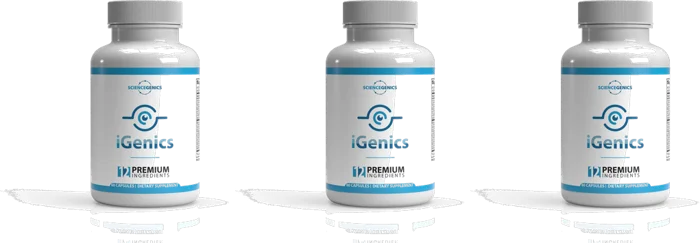
Part of our Igenics overview. Label checked October 19, 2026. Health Forge Daily earns a commission if you buy through our links; this is not the vendor's site.
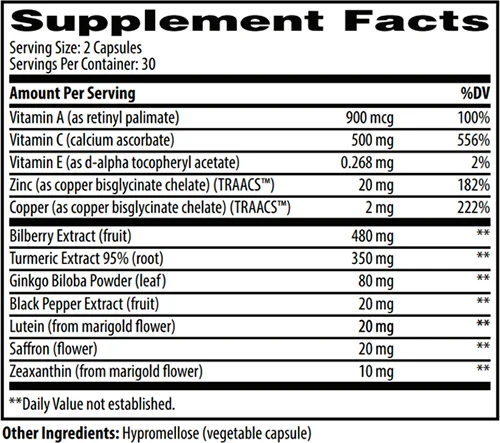
The Igenics ingredients list is easier to judge than most, because the label prints every dose. Below is the full Igenics ingredients and benefits picture: all 12 items from the vendor's Supplement Facts, what each has actually been studied for in people, and where the label falls short.[1]
What are the Igenics ingredients?
Igenics lists 12 ingredients per 2-capsule serving: vitamin A, vitamin C, vitamin E, zinc, copper, bilberry, turmeric, ginkgo, black pepper extract, lutein, saffron and zeaxanthin. All amounts are printed, and there is no proprietary blend.[1]
Each bottle holds 60 vegetable capsules, so 30 servings. The only other ingredient is hypromellose, the capsule shell.[1] The sales page calls the mix "12 clinically-backed ingredients" and an "AREDs-2 formula".[2] Those are the vendor's words. No trial of Igenics itself has been published.
What does the Igenics label list, item by item?
The table follows the label order. We added what each item is mainly studied for and how strong that evidence is for eyes. Our grading method is on the how we review supplements page.
| Label item | Per 2 capsules | Main eye research | Evidence for eyes |
|---|---|---|---|
| Vitamin A (label: "retinyl palimate") | 900 mcg (100% DV) | Beta-carotene form was in the 2001 AREDS formula, then removed[3] | Weak |
| Vitamin C (calcium ascorbate) | 500 mg (556% DV) | Part of the AREDS and AREDS2 formulas[3] | Moderate, only within the formula |
| Vitamin E (d-alpha tocopheryl acetate) | 0.268 mg (2% DV) | AREDS used 400 IU, about 180 mg[5] | Dose far too low to compare |
| Zinc (label: "as copper bisglycinate chelate") | 20 mg (182% DV) | AREDS used 80 mg; 25 mg also tested[3] | Moderate, only within the formula |
| Copper (bisglycinate chelate) | 2 mg (222% DV) | Added in AREDS to offset high zinc[6] | Supportive role only |
| Bilberry extract | 480 mg | Night vision; recent trials negative[9] | Weak, mostly negative |
| Turmeric extract 95% | 350 mg | No placebo-controlled eye trial found[10] | Weak |
| Ginkgo biloba powder (leaf) | 80 mg | Two small macular trials, 119 people[14] | Weak |
| Black pepper extract | 20 mg | Absorption booster for curcumin[12] | Not an eye ingredient |
| Lutein (marigold) | 20 mg | AREDS2 used 10 mg[15] | Moderate, within AREDS2 |
| Saffron (flower) | 20 mg | Small 3-month retinal function trials at 20 mg[16] | Limited |
| Zeaxanthin (marigold) | 10 mg | AREDS2 used 2 mg[15] | Moderate, within AREDS2 |
Which Igenics ingredients have the best evidence?
Lutein and zeaxanthin. Igenics gives lutein 20 mg and zeaxanthin 10 mg, twice and five times the AREDS2 amounts of 10 mg and 2 mg.[1][3]
In the 5-year AREDS2 trial of 4,203 people, adding these two carotenoids to the older formula gave no significant overall drop in progression to the advanced stage of age-related macular degeneration (AMD).[15] They did better than beta-carotene and were safer for former smokers, which is why the National Eye Institute (NEI) swapped them in.[3]
In a 12-month trial of 90 people, 10 mg of lutein raised macular pigment versus placebo.[18] A 60-person trial in older men used zeaxanthin at 8 mg.[19] All of this research was in people who already had a diagnosis. We found no trial showing that more than the AREDS2 amounts adds benefit, or that these carotenoids sharpen vision in healthy eyes.
What does saffron add to Igenics?
Saffron is the one herb here with a dose that matches eye trials. Igenics has 20 mg, the same amount used in small studies of people with early or mild macular changes.[16][17]
A 25-person crossover trial found better retinal responses after 3 months at 20 mg a day.[16] A later crossover trial reported an average gain of 0.69 letters on an eye chart, which the authors described as modest.[17] These studies were small and short, and none looked at whether saffron slows progression.
Do bilberry, ginkgo and turmeric help vision?
The evidence is weak for all three. They make up 910 mg of each serving, which is most of its weight, but they are the least proven items on the label.[1]
Bilberry, at 480 mg, is the biggest single dose. A review of 30 trials found that the four most recent randomized trials were all negative, and NCCIH says rigorous studies found no night-vision benefit in healthy people.[8][9]
The sales page calls ginkgo "our main ingredient", yet it is 80 mg, third among the herbs by weight.[2] A Cochrane review of two small trials said the question of whether ginkgo helps the macula "has not been answered".[14] Our main-site guide covers ginkgo biloba for memory, where large trials were negative.
For turmeric we found one uncontrolled eye study and no placebo-controlled trial.[10] The sales page says "Turmeric + Bioperine", but the label lists plain "Black Pepper Extract" with no BioPerine trademark and no piperine percentage.[1][2]
How do the Igenics vitamins and minerals compare with AREDS2?
Vitamin C (500 mg) and copper (2 mg) match AREDS2. Zinc is 20 mg against 80 mg, vitamin E is 0.268 mg against about 180 mg, and the vitamin A is a form AREDS2 does not use.[1][3]
Vitamin E is the clearest gap: 0.268 mg is about 2% of the Daily Value and roughly 0.15% of the AREDS dose.[5] AREDS2 removed beta-carotene altogether. Igenics instead adds 900 mcg of preformed vitamin A, which counts toward the adult upper limit of 3,000 mcg from all sources.[4] The full side-by-side table is on our does Igenics work page.
The 20 mg of zinc is under the 40 mg adult upper limit, and 500 mg of vitamin C is well under the 2,000 mg limit.[7][20]
What errors are on the Igenics label?
There are two. The zinc line says "as copper bisglycinate chelate", the same wording as the copper line, and vitamin A is spelled "retinyl palimate" instead of palmitate.[1]
The zinc one is probably a typo for zinc bisglycinate, but as printed it is wrong. Neither error changes the doses shown. They do suggest the label was not carefully proofread.
Some third-party pages that use the Igenics name list beta-carotene instead of retinyl palmitate, give no amounts and show an "FDA Approved" badge.[21] The FDA does not approve dietary supplements before sale, and the vendor makes no approval claim. Go by the Supplement Facts on the bottle you receive.
Are any Igenics ingredients a safety concern?
Yes, three combinations deserve a look before you start: ginkgo with blood thinners, turmeric with black pepper, and preformed vitamin A in pregnancy.
NCCIH says ginkgo may raise bleeding risk with anticoagulants such as warfarin.[13] High-absorption turmeric products have been linked to rare liver injury.[11] Piperine can also raise blood levels of some medicines, including carbamazepine.[22] Preformed vitamin A above the upper limit can harm a developing baby.[4] Dosing and who should ask a doctor first are covered in how to take Igenics.
What is our verdict on the Igenics ingredients?
The label is complete and honest about amounts, and the lutein, zeaxanthin and saffron doses are reasonable. It is still not the AREDS2 recipe the sales page implies, and the biggest doses go to the weakest herbs.
If the formula suits you, compare what you would pay on our Igenics price and coupons page, and talk to an eye doctor about any change in your sight. Back to the Igenics overview.
Frequently asked questions
What are the main Igenics ingredients?
Per 2 capsules: vitamin A 900 mcg, vitamin C 500 mg, vitamin E 0.268 mg, zinc 20 mg, copper 2 mg, bilberry 480 mg, turmeric 350 mg, ginkgo 80 mg, black pepper extract 20 mg, lutein 20 mg, saffron 20 mg and zeaxanthin 10 mg.
Does Igenics have a proprietary blend?
No. Every one of the 12 ingredients has its own printed amount, which lets you compare doses with research. The only other ingredient listed is hypromellose, the vegetable capsule shell.
Is Igenics the same as an AREDS2 formula?
No. Vitamin C and copper match AREDS2, but zinc is 20 mg instead of 80 mg, vitamin E is 0.268 mg instead of about 180 mg, and lutein and zeaxanthin are higher. It also adds herbs that AREDS2 never tested.
Does Igenics contain beta-carotene?
Not according to the vendor label, which lists vitamin A as retinyl palmitate (misspelled "palimate"). Some third-party pages list beta-carotene instead. Check the Supplement Facts on the bottle you receive.
Which Igenics ingredient has the most research for eyes?
Lutein and zeaxanthin, as part of the AREDS2 formula for people already diagnosed with intermediate or late macular changes. Saffron at 20 mg has a few small, short trials. Bilberry, ginkgo and turmeric have weak evidence for vision.
Sources
- Igenics Supplement Facts label. Science Genics (vendor), undated (read October 19, 2026).
- Igenics sales page. Science Genics (vendor), undated (read October 19, 2026).
- AREDS/AREDS2 frequently asked questions. National Eye Institute, undated (read October 19, 2026).
- Vitamin A and carotenoids: fact sheet for health professionals. NIH Office of Dietary Supplements, read via archived copy (read October 19, 2026).
- Vitamin E: fact sheet for health professionals. NIH Office of Dietary Supplements, read via archived copy (read October 19, 2026).
- Copper: fact sheet for health professionals. NIH Office of Dietary Supplements, read via archived copy (read October 19, 2026).
- Zinc: fact sheet for health professionals. NIH Office of Dietary Supplements (read October 19, 2026).
- Bilberry. NCCIH, National Institutes of Health (read October 19, 2026).
- Systematic review of 30 trials: bilberry and night vision. PubMed (read October 19, 2026).
- Turmeric. NCCIH, National Institutes of Health (read October 19, 2026).
- LiverTox: Turmeric. NIH, archived copy (read October 19, 2026).
- Shoba et al.: piperine and curcumin bioavailability. PubMed, 1998 (read October 19, 2026).
- Ginkgo. NCCIH, National Institutes of Health (read October 19, 2026).
- Cochrane review: ginkgo biloba extract and age-related macular degeneration. PubMed (read October 19, 2026).
- AREDS2 Research Group: lutein, zeaxanthin and omega-3 randomized trial. PubMed, 2013 (read October 19, 2026).
- Falsini et al.: saffron 20 mg and retinal function, crossover trial. PubMed (read October 19, 2026).
- Broadhead et al.: saffron and visual function, crossover trial. PubMed (read October 19, 2026).
- LAST trial: lutein 10 mg and macular pigment. PubMed (read October 19, 2026).
- ZVF trial: zeaxanthin 8 mg in older men. PubMed (read October 19, 2026).
- Vitamin C: fact sheet for health professionals. NIH Office of Dietary Supplements, read via archived copy (read October 19, 2026).
- Third-party pages using the Igenics name, compared against the vendor label (not linked). Various, undated (read October 19, 2026).
- Piperine and carbamazepine pharmacokinetics. PubMed (read October 19, 2026).
This page is general information, not medical advice. Dietary supplements are not reviewed by the FDA for safety or effectiveness before they are sold and are not intended to diagnose, treat, cure or prevent any disease. Talk to your doctor before taking any supplement, especially if you are pregnant, nursing, take medication or have a health condition.